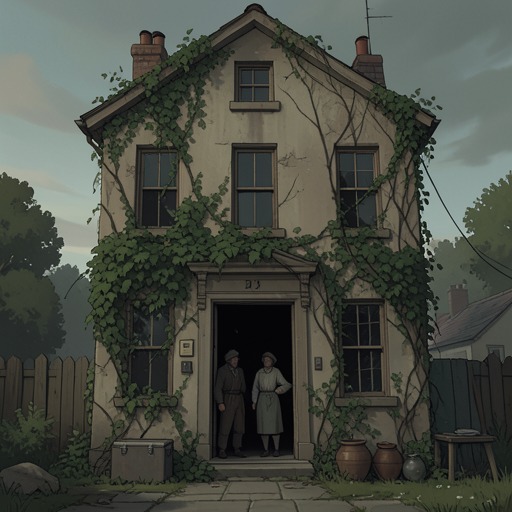
The Walking Backwards Days
The God of Small ThingsThe Walking Backwards Days describes a time in which the past remains active in ordinary life, returning as memory, bodily sensation, and inherited social order. For Estha and Rahel, history is not an abstract record: it is an experience that leaves a smell, persists in objects, and exacts a cost from those who cross its laws. The phrase also gives shape to a world where family loyalty, caste hierarchy, and official procedure move the past forward by making it recur.
Time That Does Not Stay Past
The twins do not yet understand that they will cross the river, enter a forbidden place, and be with a man they are forbidden to love. Nor do they know that they will witness history revealing itself on a back verandah. The narration casts that coming experience as an education: while other children learn other things, Estha and Rahel learn how history negotiates its terms and collects its dues. Its violence is registered through a sickening thud and a smell they never forget.
That smell is compared to old roses on a breeze, but it does not remain confined to one moment. It lurks in coat hangers, tomatoes, road tar, certain colors, restaurant plates, the absence of words, and emptiness in eyes. The list carries historical memory out of the exceptional scene and into the material textures of later life. In this sense, the past is not simply recalled; it inhabits what looks ordinary, sometimes surfacing precisely where speech is absent.
Family Memory and What Is Left Behind
The phrase “Walking Backwards days” also appears in the account of Vellya Paapen, an old Paravan who has lived through those days and is torn between loyalty and love. When he tells Mammachi what he has seen, he describes the small boat crossing the river night after night and the man and woman standing together in the moonlight, skin to skin. His testimony makes forbidden intimacy legible as a breach of inherited social boundaries, and his distress shows the pressure history exerts through bonds of family and obligation.
Another family memory survives in a black-and-white photograph Chacko took with the Rolleiflex Margaret Kochamma had given him as a Christmas present. It shows Lenin, Estha, Sophie Mol, and Rahel on the front verandah of the Ayemenem House, with Baby Kochamma’s Christmas trimmings overhead. The twins look stiff and frightened, while Sophie Mol makes an audacious face for the camera, complete with false teeth cut from a sweetlime rind, a silver thimble on her tongue, and a drawn face on her exposed knee. Shortly before the photograph, she had explained to Estha and Rahel that they might be bastards and what the word meant. The image preserves a family occasion, but also the unequal ease with which its children inhabit it and the unsettling knowledge that enters the scene.
History in Official Accounts
The past moves forward not only through family recollection but through the institutions that decide whose account will count. At the Kottayam police station, Baby Kochamma tells Inspector Thomas Mathew that a Paravan factory worker had tried to force himself on her niece, a divorcee with two children. She misrepresents Ammu and Velutha’s relationship to contain scandal and protect the family’s standing. As she tells the story, she begins to believe it, turning a deliberate distortion into an account she can inhabit.
Baby Kochamma folds her own recollection of a man who humiliated her during the march into her description of Velutha, attributing to him the insolence and fury she remembers. She emphasizes that her family educated him, trained him as a carpenter, gave his grandfather land, and provided him with a home. The Inspector’s response exposes the paternalism behind that claim of benevolence: he accuses people like her of first carrying the poor about like trophies and then seeking police help when they misbehave. Her story nonetheless becomes a First Information Report, and the Inspector promises that the accused will be caught before the day is out.
The account is shaped further by political calculation. Inspector Thomas Mathew, a Congress man, has Comrade K. N. M. Pillai brought to the station to learn whether Velutha has political backing, wary of provoking the Marxist government. Pillai says he knows Velutha but omits that Velutha belongs to the Communist Party and that he had come to Pillai’s door the night before. He does not challenge the false rape allegation; instead, he assures the Inspector that Velutha has no party protection and is on his own. The two men understand one another without trust or explanation, each working a different part of the same machinery. In this way, history becomes an official version assembled from omissions as well as accusations.
A Past Buried, a Violence Repeated
The novel sets such institutional action against the deceptively quiet present. At the History House, nothing worse seems to happen now than kebabs and caramel custard; cooks hum, ginger and garlic are chopped, and meat and fish are prepared. The Terror is said to be past. Yet something small and forgotten lies buried under grass and twenty-three years of June rain, an image that holds together concealment, elapsed time, and the persistence of what the world might claim not to miss.
The Cochin Harbor Terminus offers another view of history’s uneven passage. Its gray stationlight falls on hollow, homeless, hungry people still touched by the previous year’s famine, among toy watches with painted-on time and a cartful of defective toothbrushes. Their revolution has been postponed for the time being by Comrade E. M. S. Namboodiripad. The scene makes historical time material and unequal: public political change may be deferred, while deprivation remains present in bodies and things.
The narration finally names the violence witnessed that morning as no accident, stray mugging, or private settling of scores. It calls it a controlled demonstration of human nature’s pursuit of ascendancy, structure, order, and complete monopoly: human history masquerading as God’s Purpose before an under-age audience. The phrase “History in live performance” gathers the entry’s recurring idea into a scene. The Walking Backwards Days are not a vanished era behind the characters; they are the continuing enactment of inherited power, witnessed by children who will carry its traces into ordinary life.